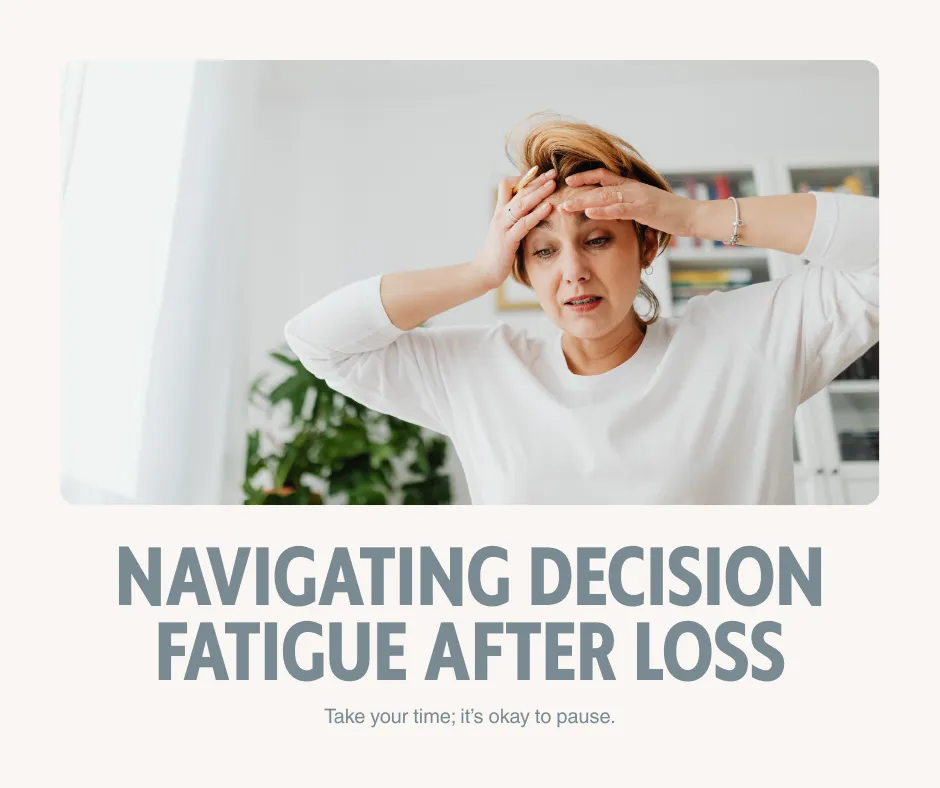
You’re Not Indecisive—Understanding Decision Fatigue After Loss
If you’ve ever stood in the kitchen staring at the fridge, unable to decide what to eat—then immediately judged yourself for it—you’re not alone.
After loss or a major life change, decision-making often becomes unexpectedly hard. Not just the big decisions, but the small, everyday ones too.
And many women quietly conclude:
“Something must be wrong with me.”
But here’s the truth most people don’t say out loud:
Difficulty making decisions after loss isn’t a personal flaw. It’s a very real part of healing.
What Decision Fatigue Actually Is
Decision fatigue isn’t about being incapable or unsure of who you are. It’s about having a system that’s been under prolonged strain.
Loss—whether from grief, betrayal, caregiving, or a major identity shift—requires constant internal calculation:
What’s safe?
What’s expected?
What might fall apart if I choose wrong?
Over time, that constant vigilance exhausts the part of the brain responsible for executive function—planning, prioritizing, and choosing.
So when someone says, “Just decide,” it misses the point entirely.
Your system isn’t lazy.
It’s tired.
Why Even Small Choices Can Feel Overwhelming
One of the most confusing parts of decision fatigue is how disproportionate it feels.
You may be capable of handling complex responsibilities—work, family, logistics—yet feel undone by:
Choosing where to go
Deciding what to say yes or no to
Making plans for the future
Committing to anything that feels permanent
This happens because loss often removes our internal sense of safety.
When safety is compromised, the nervous system treats every decision as potentially risky—even ones that used to feel neutral.
That’s not weakness.
That’s protection.
The Cost of Forcing Clarity Too Soon
Many women respond to decision fatigue by pushing harder.
They tell themselves:
“I should know this by now.”
“Other people seem fine.”
“I just need to be more decisive.”
But forcing clarity before your system feels safe enough to hold it often backfires.
Instead of confidence, it creates:
More self-doubt
More second-guessing
More emotional exhaustion
Healing doesn’t happen by overriding yourself.
It happens by listening differently.
A Gentler Way to Rebuild Decision Confidence
Rebuilding decision confidence after loss doesn’t start with big choices.
It starts with low-stakes, self-honoring ones.
Things like:
Choosing rest without justifying it
Letting a decision be “good enough”
Noticing which options create relief instead of urgency
Giving yourself permission to delay
These small choices send an important signal to your system:
“I’m listening now. You’re not alone.”
Over time, that’s how clarity returns—not all at once, but steadily.
You’re Not Behind—You’re Regulating
If decision-making feels harder than it used to, it doesn’t mean you’re stuck or failing.
It means your system is recalibrating after change.
And that recalibration deserves patience, not pressure.
You don’t need to have answers yet.
You don’t need to force certainty.
You don’t need to decide your entire future.
Sometimes the most self-trusting choice is allowing yourself to heal before you choose.
If This Resonates
This month, I’m exploring what it means to rebuild self-trust after loss—starting with understanding how our systems respond to change.
If decision fatigue has been part of your experience, you’re not alone. And you don’t have to push your way through it.
Healing isn’t indecision.
It’s discernment taking its time.